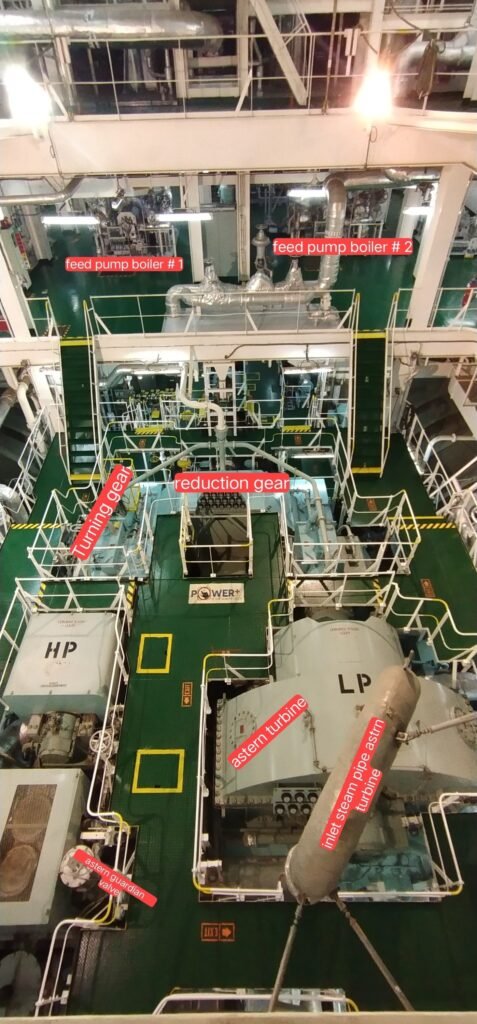
Ever wondered what keeps a massive LNG carrier moving steadily across oceans? The answer lies deep inside the ship: the steam turbine engine room, a world of heat, pressure, and relentless power.
🔥 Boilers #1 & #2
The journey begins here. High‑pressure water is heated into powerful steam, the lifeblood of the turbines.
⚙️ Turning Gear
Before the turbine runs at full speed, it is slowly rotated to prevent mechanical stress and keep the system safe.
⚡ Reduction Gear
Turbines spin at thousands of revolutions per minute, but the propeller needs smooth, controlled motion. Reduction gears tame this raw energy into steady propulsion.
🚀 High‑Pressure Turbine (HP Turbine)
This is where steam first unleashes its explosive energy, driving the initial stage of motion.
🔄 Low‑Pressure Turbine (LP Turbine)
After passing through the HP turbine, steam still holds energy. The LP turbine extracts every remaining drop of power, ensuring maximum efficiency.
🛑 Astern Turbine
Not all movement is forward. The astern turbine gives the ship the ability to stop or move backward with precision — essential for maneuvering in ports.
✨ Conclusion
The steam turbine engine room is more than machinery; it is the beating heart of an LNG carrier, transforming steam into unstoppable motion across the seas. It represents the perfect blend of engineering power and maritime precision.